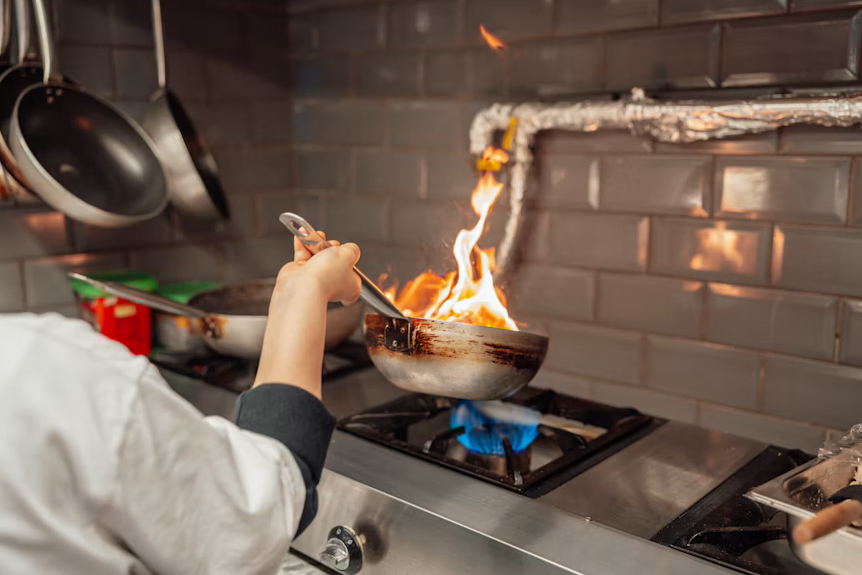
Over recent months, cooking emissions have emerged as an area of growing interest among the Breathe London Community Programme groups. Through our community learning sessions, groups have been exploring how different sources of air pollution affect their neighbourhoods and what can be done to improve the air we breathe. In response to this interest, we have welcomed two guest speakers to share their knowledge and experiences: Dr Ian Chen from Imperial College London and a speaker from the Global CookSafe Coalition.
“As we reduce vehicle and other emissions in urban environments across Europe, commercial cooking is becoming the most important primary source of particle pollution and yet there is little regulation in place. Technologies which remove the particles and gases can effectively reduce these emissions – these are required by law in Hong Kong.” Dr Ian Chen
These conversations have opened up discussion about a source of air pollution that often receives less attention than traffic: emissions from commercial kitchens, restaurants and takeaways. They have also highlighted the importance of looking beyond familiar sources of pollution to understand the issues that matter to communities and the practical solutions available to them.
An overlooked source of air pollution
From busy takeaway kitchens, the rise of ‘dark kitchens,’ to charcoal grills and restaurant clusters on high streets, cooking generates emissions that can affect the air we breathe. As London continues to tackle air pollution, understanding the contribution of commercial cooking is an increasingly important part of the picture.
Cooking produces a mixture of pollutants. Heating oils and fats, frying food and grilling meat release fine particulate matter, including PM2.5, alongside ultrafine particles and volatile organic compounds. Where kitchens use gas or solid fuels such as charcoal, combustion can produce additional pollutants, including nitrogen dioxide and carbon monoxide.
These emissions can enter the outdoor environment through kitchen extraction systems and ventilation outlets. Depending on the cooking method, equipment and effectiveness of filtration, they can contribute to pollution in surrounding streets and neighbourhoods.
Estimates from London's emissions inventories suggest that commercial cooking accounts for around 8% of the capital's PM2.5 emissions1. An earlier estimate attributed as much as 60% of PM2.5 emissions in central London to commercial cooking. These figures relate to different years, geographical areas and inventory estimates, but they illustrate an important point: cooking can be a substantial source of particulate pollution, particularly in areas with high concentrations of restaurants.
Why does cooking pollution matter? And how does it impact certain people and communities disproportionately?
Restaurant and takeaway workers may experience repeated exposure to cooking emissions during long shifts. People living above or alongside restaurants may be exposed to emissions released close to their windows and balconies. Meanwhile, pedestrians, shoppers and others spending time in busy commercial areas may encounter localised pollution hotspots.
Children, older people and people with existing respiratory or cardiovascular conditions can be particularly vulnerable to air pollution.
Although the health impacts of particulate pollution are well established, the specific contribution of cooking emissions to illness across London remains less well understood. More research is needed to connect emissions estimates with people's actual exposure and the resulting health impacts.
One of the most important features of cooking emissions is that their impact can vary considerably between neighbourhoods.
Across Greater London, road transport remains an important source of air pollution. However, in areas with dense concentrations of restaurants, takeaways and commercial kitchens, cooking can make a much larger contribution to local particulate emissions.
The location and design of extraction systems also matter. An exhaust outlet that releases emissions close to residential windows or into a poorly ventilated street may create a different exposure risk from one that disperses emissions effectively. The type of food being cooked, cooking temperatures, fuel sources and the maintenance of filtration equipment all influence the amount and composition of emissions.
This means that city-wide averages do not necessarily reflect what people experience on their own streets.
For Breathe London community groups, understanding these local differences is an important part of building knowledge about the pollution affecting their neighbourhoods. Conversations with researchers and practitioners provide an opportunity to explore the evidence, ask questions and consider how this knowledge can inform community action.
Different boroughs, different approaches
Across London, boroughs are beginning to explore different approaches to tackling cooking emissions, reflecting the varying challenges and opportunities in their local areas. Westminster City Council has been leading the way through its work to better understand emissions from commercial kitchens and trial potential solutions, including air-purification technology in restaurants. This is particularly relevant in Westminster, where the high concentration of restaurants and takeaways means cooking emissions can make a significant contribution to local air pollution. The council’s initiative offers an opportunity to explore how businesses can reduce emissions in practice, while generating learning that could inform approaches in other boroughs. Sharing this learning across London will be important to help councils, communities and businesses identify effective, proportionate ways to tackle cooking emissions and improve local air quality.
Over the next few months, we will be exploring with our groups more around how we can work with local businesses and local authorities to understand more around cooking emissions and their impact on air quality in London.